THREE WAYS TO LOOK ACROSS WORKS

Compare with a question.

Choose one difference to investigate. These pairings turn a seven-work sample into a short looking exercise; they are not a survey of Japanese art.

Similar height, different direction

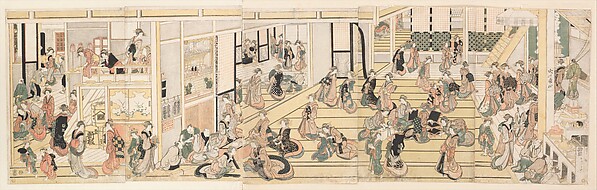
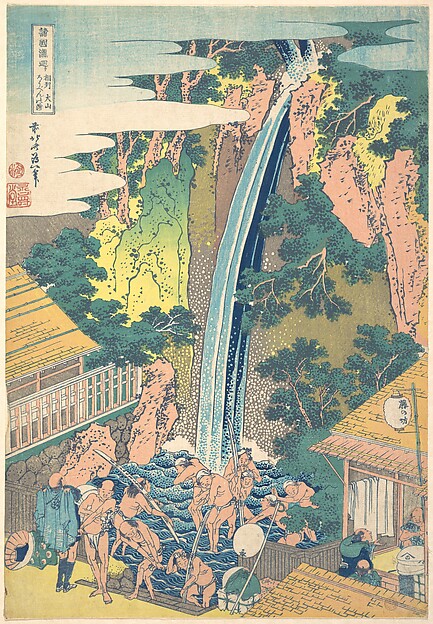
Two Hokusai prints make a controlled comparison: the recorded heights are close, while one composition extends across five sheets and the other climbs a narrow page.

Images fit their panels; they are not shown at the same physical scale.

New Year's Day at the Ōgiya Brothel, Yoshiwara
New Year's Day at the Ōgiya Brothel, Yoshiwara · JP29a–e
Image: The Metropolitan Museum of Art · CC0 1.0 · Unaltered source JPEG.

A room too wide for one glance

Attribution
Katsushika Hokusai
Date label
ca. 1804
Materials
Pentaptych of woodblock prints; ink and color on paper
Dimensions
Oban, pentaptych: 14 15/32 x 48 1/2 in. (36.8 x 123.2 cm)
Accession number
JP29a–e
Museum record ↗
Rōben Waterfall at Ōyama in Sagami Province (Sōshū Ōyama Rōben no taki), from the series A Tour of Waterfalls in Various Provinces (Shokoku taki meguri)
Rōben Waterfall at Ōyama in Sagami Province (Sōshū Ōyama Rōben no taki), from the series A Tour of Waterfalls in Various Provinces (Shokoku taki meguri) · JP2
Image: The Metropolitan Museum of Art · CC0 1.0 · Unaltered source JPEG.

A waterfall that sets the pace

Attribution
Katsushika Hokusai
Date label
ca. 1827
Materials
Woodblock print; ink and color on paper
Dimensions
14 3/4 x 10 1/4 in. (37.5 x 26 cm)
Accession number
JP2
Museum record ↗

Try the comparison

  1. Before reading the titles, draw an imaginary path through each picture with your eyes. Identify the line or shape that starts it.
  2. Compare a small group of figures in each. Ask how the architecture or landscape changes their prominence.
  3. Read the dimensions after looking. A same-width web thumbnail hides the physical difference; these pictures are shown to fit, not at a shared scale.

You can compare the effect of format here without claiming that all wide pictures feel the same, or that these two works summarize Hokusai’s career.

Back to comparison choices ↑

Surface and openwork: two sword guards

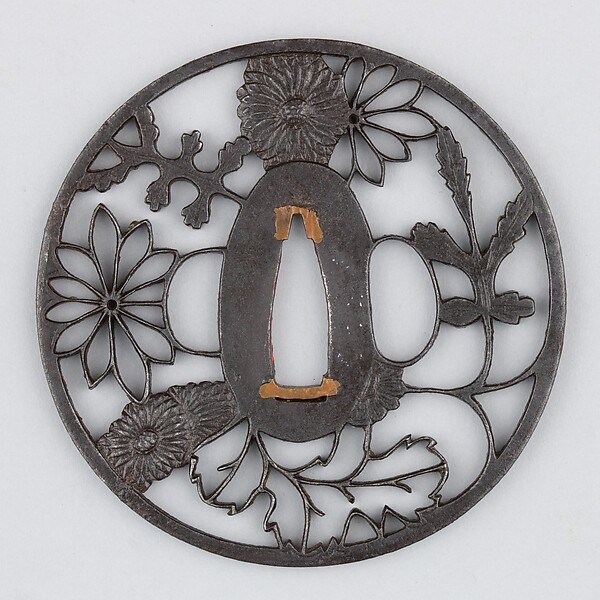
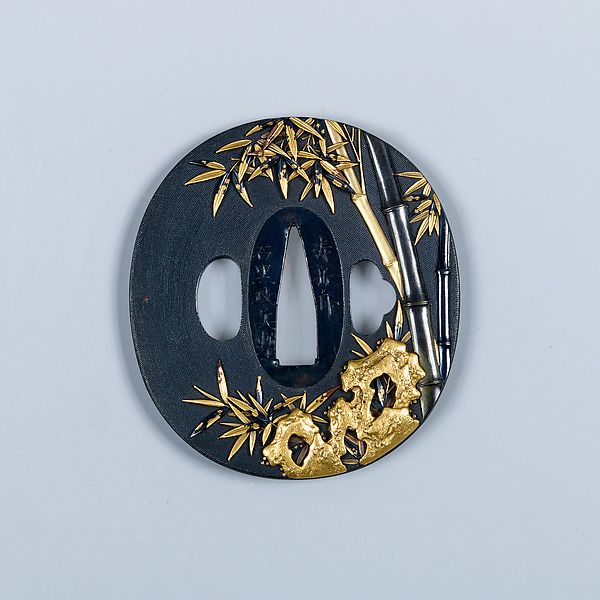
A shared object name makes the differences easier to investigate. The earlier record lists iron and 56.7 g; the later one lists several metals and alloys and 153.1 g.

Images fit their panels; they are not shown at the same physical scale.

Sword Guard (Tsuba)
Sword Guard (Tsuba) · 36.120.162
Image: The Metropolitan Museum of Art · CC0 1.0 · Unaltered source JPEG.

Flowers made visible by empty space

Attribution
Attributed to the Hagi school
Date label
16th century
Materials
Iron
Dimensions
Diam. 3 1/8 in. (7.9 cm); thickness 1/8 in. (0.3 cm); Wt. 2 oz. (56.7 g)
Accession number
36.120.162
Museum record ↗
Sword Guard (Tsuba)
Sword Guard (Tsuba) · 36.120.79
Image: The Metropolitan Museum of Art · CC0 1.0 · Unaltered source JPEG.

Bamboo around an opening

Attribution
Inscribed by Ishiguro Masayoshi
Date label
19th century
Materials
Copper-gold alloy (shakudō), gold, copper-silver alloy (shibuichi), copper
Dimensions
H. 2 7/8 in. (7.3 cm); W. 2 5/8 in. (6.7 cm); thickness 5/16 in. (0.8 cm); Wt. 5.4 oz. (153.1 g)
Accession number
36.120.79
Museum record ↗

Try the comparison

  1. Locate the central opening in each, then examine how the ornament relates to it.
  2. Compare the open floral structure with the larger continuous dark field around the bamboo. Describe what you can see before explaining why it was made.
  3. Check the attributions: “Attributed to the Hagi school” and “Inscribed by Ishiguro Masayoshi” make different claims. Neither should be silently shortened to “made by.”

Weight is a useful catalogue difference, not a verdict on quality or usability. One measurement is a diameter; the other gives height and width, so no diameter-to-height size ratio is implied.

Back to comparison choices ↑

Crowding, contour and breathing room

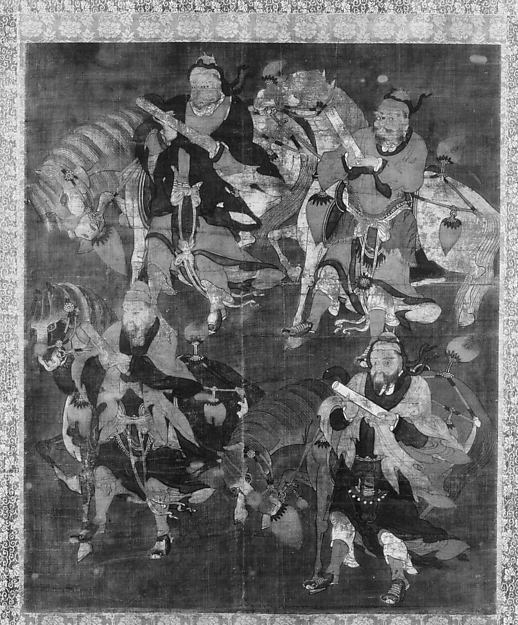
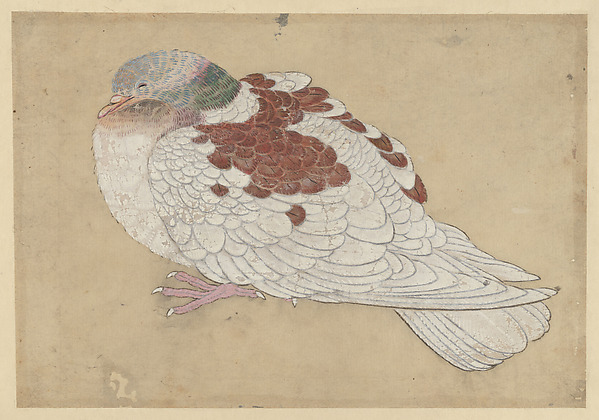
A hanging scroll with several overlapping figures and a watercolor with one bird offer two different outline-reading exercises.

Images fit their panels; they are not shown at the same physical scale.

Four Deities with Horses
Four Deities with Horses · 29.100.460
Image: The Metropolitan Museum of Art · CC0 1.0 · Unaltered source JPEG.

Four figures, one crowded field

Attribution
Unidentified
Date label
Not recorded
Materials
Hanging scroll; ink and color on silk
Dimensions
28 1/2 x 22 31/32 in. (72.4 x 58.4 cm)
Accession number
29.100.460
Museum record ↗
Bird
Bird · 29.100.945
Image: The Metropolitan Museum of Art · CC0 1.0 · Unaltered source JPEG.

The rhythm inside one bird

Attribution
In the Style of Ogawa Haritsu (Ritsuō)
Date label
18th century
Materials
Watercolor on paper
Dimensions
7 1/32 x 10 7/32 in. (17.9 x 26 cm)
Accession number
29.100.945
Museum record ↗

Try the comparison

  1. Spend 20 seconds following a single silhouette in each image. Note where you have to stop or change direction.
  2. Compare repeated shapes inside a figure with the open area outside it. Which does more to hold your attention?
  3. Keep the evidence separate: the scroll’s supplied photograph is monochrome, its medium includes color, and its date label is missing. The bird has a qualified stylistic attribution.

This pairing is about what these images let us see. It does not establish a relationship between the makers, a shared purpose, or a chronology for the undated scroll.

Back to comparison choices ↑

Original questions and image observations by GIZUMO. Catalogue facts and unchanged images: The Metropolitan Museum of Art, linked beside each work. Editorial review: 6 October 2026. No assertion about current exhibition status.