INDEPENDENT LOOKING GUIDE · ABOUT 2 MINUTES
Shibata Zeshin — Parody of the Four Accomplishments
A field that keeps unfolding
Parody of the Four Accomplishments
Let the longest lines show you the way in.
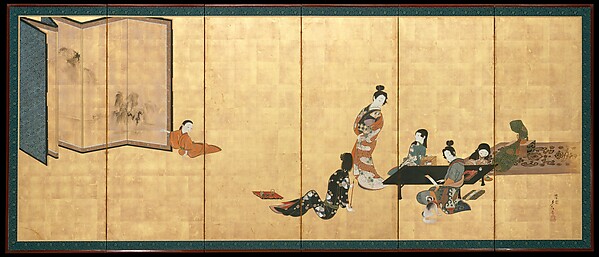
Image: The Metropolitan Museum of Art · CC0 1.0 · Unaltered source JPEG.
Look first
- Start at the far left and trace the longest horizontal lines across the image. Then follow one diagonal. Which line carries your eye furthest?
- Find the men and follow every place it appears. Compare the clearest example with the smallest or most easily missed one.
- Enlarge the image and move close to the brushwork, then step back. Which strokes carry the form, and which read only as texture at a distance?
Put the format in context
The catalogue dates this work to second half of the 19th century and records Pair of six-panel folding screens; ink and color on gold leaf on paper. The attribution reads “Shibata Zeshin.” The catalogue places the work in the late Edo (1615–1868) or Meiji (1868–1912) period.
A question for your next visit
On a second look, ignore the figures for 30 seconds. Does the structure still lead you through the scene in the same order?
Open the collection to save a work on this browser, or bookmark this guide’s address.
Check the original record and image
- Attribution
- Shibata Zeshin
- Date label
- second half of the 19th century
- Materials
- Pair of six-panel folding screens; ink and color on gold leaf on paper
- Dimensions
- each screen: 47 1/2 in. × 9 ft. 4 1/2 in. (120.7 × 285.8 cm)
- Accession number
- 51.89.1, .2
Museum record ↗ · Original image ↗
Museum credit line: Fletcher Fund, 1951
Source metadata date: 2026-06-03T04:56:30.59Z
Record/image retrieved: 2026-11-01T00:44:51Z
The looking prompts are GIZUMO’s own observations and questions, not statements of artist intention. Catalogue facts are from the linked source. Guides reviewed 1 November 2026; the collection is a dated snapshot, not live display or availability information.