INDEPENDENT LOOKING GUIDE · ABOUT 2 MINUTES
Gyokuen Bonpō — Orchids and Rock
A long look, top to bottom
Orchids and Rock
Read it twice: once going down, once climbing back.
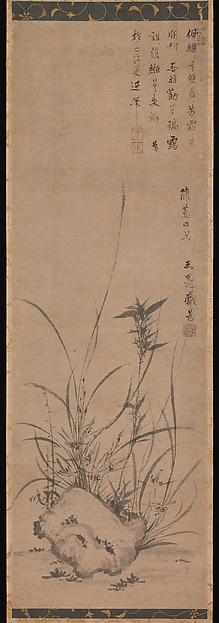
Image: The Metropolitan Museum of Art · CC0 1.0 · Unaltered source JPEG.
Look first
- Follow the strongest vertical from the top of the image to the bottom. Then reverse direction. Which route feels faster, and why?
- Find the orchid and follow every place it appears. Compare the clearest example with the smallest or most easily missed one.
- Enlarge the image and move close to the brushwork, then step back. Which strokes carry the form, and which read only as texture at a distance?
Put the format in context
The catalogue dates this work to late 14th–early 15th century and records Hanging scroll; ink on paper. Its recorded size, 100.5 × 33.4 cm, gives the composition its climb; on a phone screen you will meet it in slices rather than all at once. The attribution reads “Gyokuen Bonpō.” The catalogue places the work in the Muromachi period (1392–1573).
A question for your next visit
Scroll back to the top and descend once more, slowly. Where does your eye rest longest on the way down?
Open the collection to save a work on this browser, or bookmark this guide’s address.
Check the original record and image
- Attribution
- Gyokuen Bonpō
- Date label
- late 14th–early 15th century
- Materials
- Hanging scroll; ink on paper
- Dimensions
- 39 9/16 x 13 1/8 in. (100.5 x 33.4 cm)
- Accession number
- 1975.268.38
Museum record ↗ · Original image ↗
Museum credit line: The Harry G. C. Packard Collection of Asian Art, Gift of Harry G. C. Packard, and Purchase, Fletcher, Rogers, Harris Brisbane Dick, and Louis V. Bell Funds, Joseph Pulitzer Bequest, and The Annenberg Fund Inc. Gift, 1975
Source metadata date: 2026-02-28T04:58:01.027Z
Record/image retrieved: 2026-11-01T00:39:17Z
The looking prompts are GIZUMO’s own observations and questions, not statements of artist intention. Catalogue facts are from the linked source. Guides reviewed 1 November 2026; the collection is a dated snapshot, not live display or availability information.