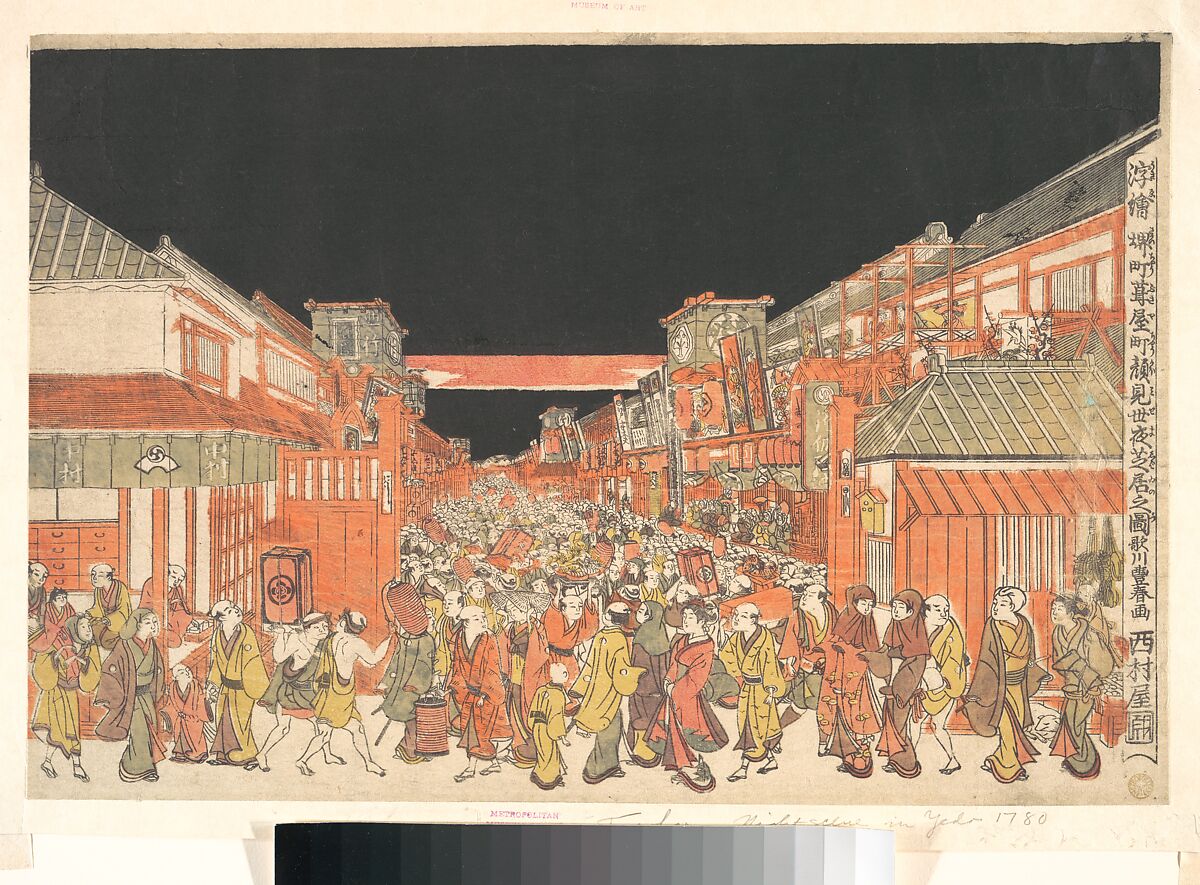
Uki-e: How Converging Lines Create a Sense of Depth
Follow the spatial device in a Japanese perspective print, then distinguish convincing depth from reliable information about a place.
How do the lines in a Japanese perspective print organise depth, and what does that effect establish?
Historical and collection documentation only. No current exhibition, admission, opening-hours, price or authenticity claim.
Start with a print that looks into space
The Metropolitan Museum of Art dates Utagawa Toyoharu’s perspective print of Edo’s Sakaichō and Fukiyachō theatre district to about 1780. Its explanation places Toyoharu’s use of one-point perspective in outdoor scenes alongside earlier experiments with interiors by Okumura Masanobu. The useful first question is how a flat printed surface can invite the eye to travel into a street.
Sources: U1
Getty’s Art & Architecture Thesaurus explains one-point perspective through a single vanishing point. The image makes a set of parallel edges running away from the viewer converge towards that point, creating an impression of depth. The lines meet in the representation; the method does not require the corresponding edges in the imagined space to be physically joining together.
Sources: U2
Follow a set of edges, not every mark
On a reproduction, choose edges that appear to describe the same receding direction. Trace them on a separate sketch and ask whether their extensions approach a shared point. Do not force every line, including upright posts or transverse edges, into that test. You are investigating one set of spatial relationships, not demanding that every mark aim at the same spot.
Sources: U2
The Met identifies the setting as Edo’s theatre quarter during the opening performances of the Kabuki season. Return to the people and signs after examining the spatial framework. The museum’s subject identification and your observation of depth answer different questions: what occasion the print represents, and how the design organises the view of it.
Sources: U1
A persuasive space may carry a misleading place-name
Maidstone Museum provides a revealing comparison in a print it believes was made by Toyoharu, titled Dutch View of Franciscan Monastery. Its collection essay points out that the title refers to Holland while the architecture includes Roman ruins. A convincing impression of space can therefore coexist with a confused geographical identification.
Sources: U3
The museum connects the design with European copperplate images and notes that its arrangement reverses the comparable Roman imagery. It treats tracing a source print onto a woodblock as a probable explanation, not a demonstrated event. These qualifications matter: the image offers evidence of adaptation, without requiring the Japanese designer to have stood in the place represented.
Sources: U3
Describe the effect before trusting the destination
Describe the edges that help you read distance, then check the museum’s account of the setting and source image. Constructing deep space remains an achievement even when a title misidentifies the place. Visual conviction does not settle documentary accuracy.
Sources: U3