Fan Paintings: Does a Fan Shape Prove the Picture Was Once Used?
Compare two documented fan paintings to see why present shape, original use and later mounting require separate evidence.
Can a fan-shaped painting or a hanging-scroll mounting tell us what the work originally was?
Historical and collection documentation only. No current exhibition, admission, opening-hours, price or authenticity claim.
Treat the outline as a question
A fan-shaped painting invites an easy story: someone once carried it, and later it became a picture for display. Kyoto National Museum explains that paintings from fans could indeed be remounted as hanging scrolls, screens or albums. Yet that documented possibility is a starting point for investigation, not proof of the history of every work with a curved outline.
Sources: F1
Separate three entries in your notes: the shape you see, the format named in the catalogue and the history the catalogue actually supplies. These entries may agree, but they answer different questions. A visible silhouette describes the present work; it cannot by itself establish how an earlier owner held, used or displayed it.
A surviving outline may itself be a later change
Kyoto National Museum’s painting by Josetsu, Wang Xizhi Writing on a Fan, depicts an anecdote about the Chinese calligrapher writing on fans for an elderly seller. The museum traces a different history for the Japanese painting itself. An inscription of 1430 records its remounting as a hanging scroll; the account explains that the original fan painting was cut into a Chinese-style fixed-fan outline during that change of format.
Sources: F2
Two histories therefore need to be kept apart: the action represented in the picture and what later happened to the painted object. The people shown with fans do not prove how this painting was used. Nor does its surviving contour preserve its original shape unchanged. In this case, the museum’s account of remounting supplies information that the outline alone cannot.
Sources: F2
Another fan-shaped picture was never a usable fan
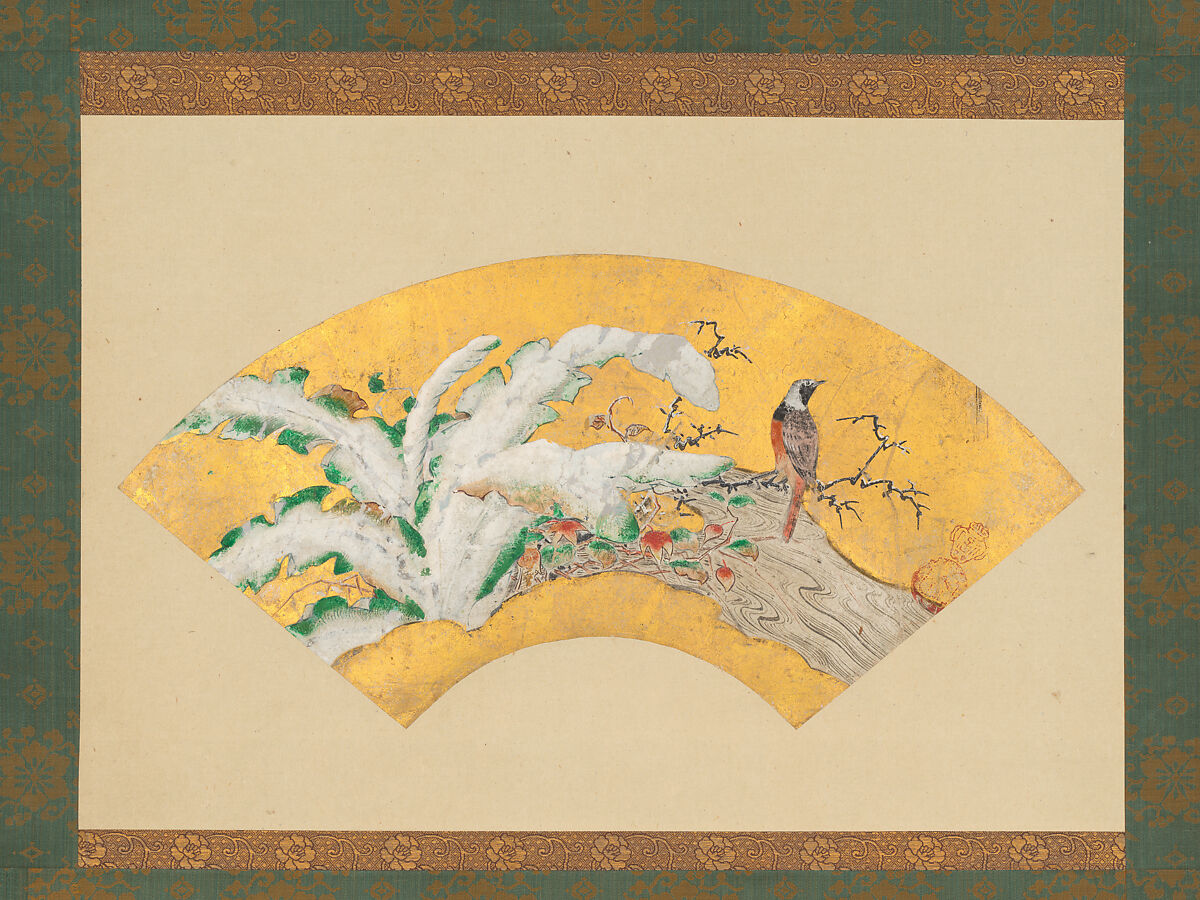
The Met’s Plantain and Bird in Snow, attributed in its record to Kanō Sōshū and dated to the late sixteenth century, offers a useful counterexample. The museum explicitly states that it was never mounted as a usable fan. It belonged to a group of sixty fan-shaped paintings in two albums. Its shape was compatible with an album setting from the outset.
Sources: F3
The same account explains that the group was later divided into an album containing forty-nine paintings and several hanging scrolls, including this one. Thus its present scroll format and its fan-shaped image belong to different parts of its history. Neither requires an intervening stage in which this particular painting served as a hand-held fan.
Sources: F3
Ask for a history rather than supplying one
When a catalogue gives no account of earlier mounting or use, leave that stage open. Make a list of the missing evidence instead of supplying an attractive biography. The reward is a more interesting question than “Is it fan-shaped?”: which parts of the work’s present appearance belong to its making, and which belong to its later life?